

Egypt: Displaced from the Nile to the Derwent
For over 4 years we’ve been busy working to better conserve, research, store, interpret and display the material from ancient Egypt in the care of Derby Museums.
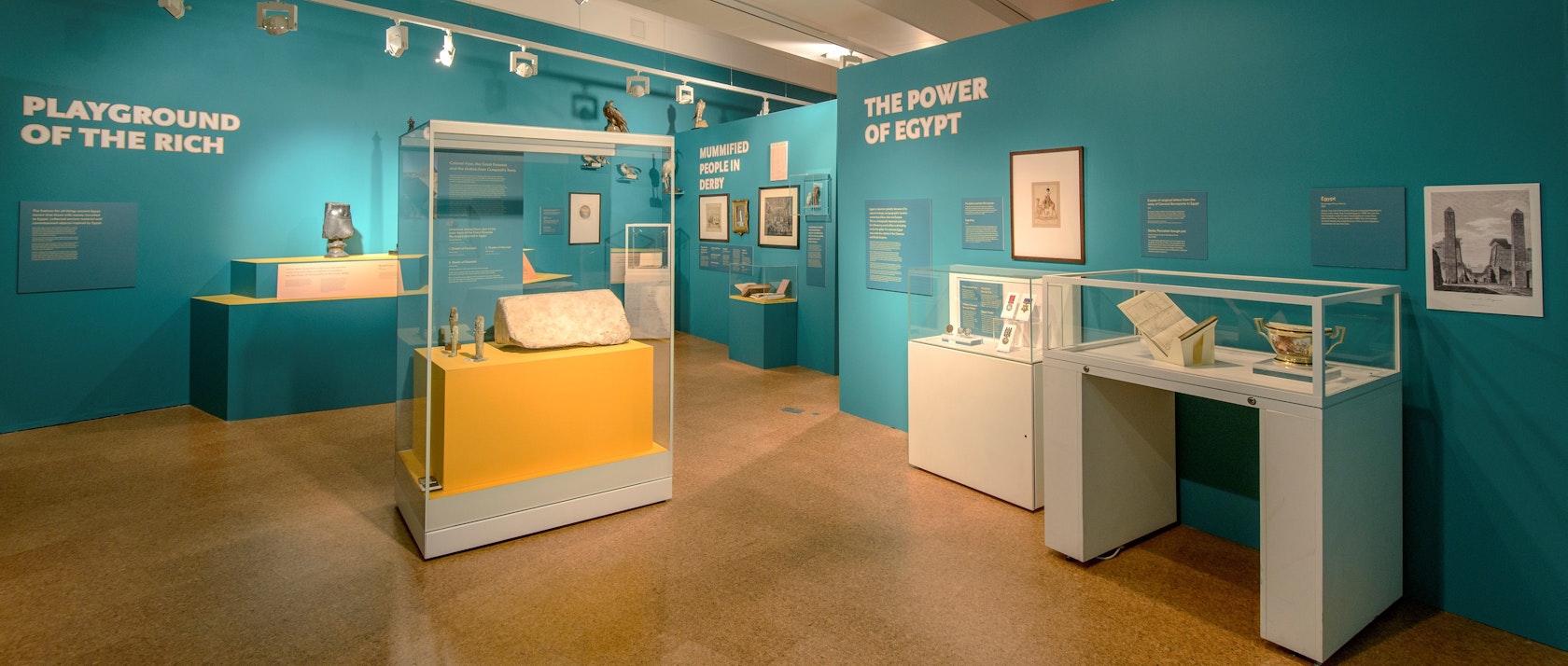
We have been collaborating with Egyptologists and learning and community specialists in the UK, Europe and Egypt. We wanted to update the very tired and hard to access displays at the Museum and Art Gallery, but wanted to do this in a participatory way to include Egyptian voices and develop our ideas with our audiences. Due to the popularity of our school’s programme we chose to work with Primary Schools. Derby Museums’ Learning and Curatorial teams worked together and developed a project lab exhibition called Displaced: from the Nile to the Derwent, new learning programmes and resources and a new more permanent display in the World Collection Gallery at the Museum and Art Gallery.
We found that the research around our collections was in need of updating and the records (most dating from the later 1800s and early 1900s) relating to the collections were poor. There were many reasons for this (it’s not unusual for historic collections) but there has never been an Egyptologist on the staff team at Derby Museums and most of the collections came from private collections where records often aren’t kept, or passed on, by collectors. The collection itself is fascinating, but offers no consistency, with small amounts of material from many time periods (and quite a few locations) across the huge span of time and geography we tend to simplify under the term ‘ancient Egypt’. We found it couldn’t tell many of the stories that visitors wanted (Tutankhamun and Howard Carter or the origins of the Pyramids) but it could tell lots of stories about the connections between Derby and Egypt over several centuries. Exciting for us then, when our school partners explained that connecting the history curriculum to local stories was something important to them that we could help with!
Supported by an Art Fund Headley Fellowship, members of our curatorial team were able to undertake lots of research and including a visit to Egypt to meet specialists there. They talked a lot about objects in the collection and about how to look after the two mummified ancient Egyptian men in the care of Derby Museums, called Pypyu and Pa-Sheri. Part of the visit connected the Future International School in Luxor with The Bemrose School, Derby. Learning together these future Egyptologists helped each other to learn about what life is like today as well as exploring together material from Egypt’s ancient past. Their conversations and opinions have helped reshape our learning offer and our displays.
The Displaced: from the Nile to the Derwent exhibition highlighted our collaborations ad allowed us to test our ideas – finding out with our audiences how they felt about the collection, what they wanted to know and how we might best design new, more permanent displays. Central to this was asking visitors how they felt about encountering the mummified remains of Egyptian ancestors, in museums. We tried to tell the stories of the lives of Pypyu and Pa-sheri with the information available and developed this with amazing loans from the British Museum, Manchester Museum and Chatsworth House. We encouraged visitors to reflect on the history of displacement of Egyptian mummified people and material culture from Egypt and its interconnection with European colonialism and western fascination with excavations there – which continues today.
Pypyu and Pa-sheri continue to be on display and have been recently conserved. We hope we are now offering visitors a more reflective and careful experience on-gallery, with options not to view their bodies and to consider personal responses to encountering human remains in museums. New interpretation explores what we can piece together about their lives and the ethics of their treatment after their tombs were opened by early archaeologist/explorers. We will continue our research and welcome responses to our work. The Conservation was made possible through a partnership with the University of Lincoln and a generous grant from the Pilgrim Trust.
Our partners for this project:
Thank you to the following organisations for their generous contributions to this project:


Reinterpreting the collections from ancient Egypt in the care of Derby Museums.


Egyptian Knowledge - Connecting schools: Derby and Luxor.
Conversations With Luxor.
Excerpt taken from Laura Phillips’ speech at the opening of the exhibition:
“At Derby Museums we base our work on coproduction and the idea of connecting to our collections and our audiences with our heads, hearts and hands.
We’ve been reflecting on the collections from Egypt that are cared for by Derby Museums, including the remains of two mummified Egyptians, PyPyu and Pa-sheri. Many collaborators have given their time and knowledge to help us better understand Derby’s collection unpicking the inaccuracies and fill in the gaps in the records around these collections. As well as helping us find our way through the ethical complications of collections connected to Britains colonial past, particularly those that include human remains.
The collection is relatively small with material originating from different places and times – from the an ancient Egyptian timeline spanning over 3000 years). It is a remarkable collection, drawing together rare and fascinating objects many of which can tell us more about Derby than Egypt.
Most material entered the museum via local, private collections well over 100 years ago – and we have never had an Egyptologist on staff to research them. This makes collections research an ongoing and sometimes frustrating task.
We wanted to draw on Egyptian voices and have been able to connect with specialists in Cairo and Luxor. They have shaped the exhibition, not least in helping us re-assess the provenance of certain objects and connecting collections here with source material and heritage locations in Egypt.
We know learning information about ancient Egypt and visiting museums is (and has been for several generations) a regular feature of UK primary education. We felt we had a responsibility to better understand this and both support and enrich this learning – working with children and their teachers to help develop displays and learning programmes.
Young ideas and the exchange of information about contemporary Derby and Luxor has been as important in creating this exhibition as the sharing of knowledge about cultural heritage.
In our new displays, we’ve wanted to create a space for reflection and emotion – the head and the heart. This, we hope, is particularly evident in the display of the two mummified people in our collection, Pypyu and Pa-sheri. We have changed the language in our displays to emphasise that we are caring for people – that these are not museum objects. We have tried to communicate that these were two individuals that lived around 300 years apart. We are as honest as possible about their care now and historically. We hope we offer dignity and respect to them, and our visitors, through providing calm but beautiful spaces that visitors can choose to enter.
Egyptian colleague Nagwa Bakr from the National Museum of Egyptian Civilisation, Cairo had this to say about Egyptian ancestors in UK Museums:
‘it is a little bit hard to give the answer because of the mix of feeling. For people in Upper Egypt it is not easy…for our ancestors to leave.. for your ancestor (to be) outside your family, but at the same time, once I visit any museum outside Egypt I feel proud. I feel proud by my culture, by my civilisation’
Many aspects of this collection might intrigue and fascinate the head, and we have ensured our collections are better documented, stored and displayed for young and old learners and researchers to access much more easily. But these collections also tug on the heart… and much of our recent and current work with them has not just provoked mixed emotions but real concern around ethics, care and responsibility.
At a time when it is easy to find encouragement to form hardened, binary opinions… we hope we are creating spaces for thinking and considering, for accepting there are often no easy answers, for connecting personally, and for holding or considering multiple viewpoints.”