


Studios, Club & Log Boat Seat
Welcome to Autumn and back to the Workshop blog.
The Museum of Making Workshop has the equipment and space for all kinds of creation. But, for those that don’t already know, we have another wonderful space at the Museum! The Studios reside on the floor above the Workshop. This space is used frequently by Derby Museum’s Learning team and also hosts lots of Workshop courses. The space features smaller, manageable equipment that is ideal for when we have younger groups making. The Studios also have a number of working tables and home to some of our equipment, such as laser cutters, sewing machines, a vacuum former and more.

Amongst our team, we have experience in garment construction, pattern cutting and sewing machine use, and during a recent project we were reminded of the usefulness of a large space to work when laying out, measuring and cutting fabric.
We therefore want to raise the visibility of this space, let you know it’s available for making and provide times for working there more regularly. A large step forward into making the Studios more accessible, is our new Friday morning sessions.

Studios | Space to make
The Studios are large, open and spacious. The space has many tables suited to a range of work, and are particularly conducive to working with textiles.


In the Studios, we have sewing machines, overlockers, an embroidery machine and an industrial ironing board, with a vacuum and heated bed.


We have lots of available equipment, including scissors, pattern masters and tailors chalk, to use if you don’t have your own.

Tables can be grouped together to work on full rolls of fabric, on makes such as curtains – and taller tables allow for easier pattern cutting.

Friday Morning Sessions
Every Friday morning, 10am – 1pm, we are making the Studios available for Maker bookings.
The Workshop is a welcoming space for any of your projects, and we can bring sewing machines into the space, however, the Studios is a quieter and cleaner space.
So, whether you need a piece of equipment, a large table space, or just a dedicated slot of time in your week for making, book yourself in for a Workshop and Studios induction and join our Friday Studio Sessions.
A Technician will be on hand for support.
When you sign up to use the Workshop, you will also have access to the Studios.
Book a Maker Induction here
Craft & Making Club
In the Workshop we have the honour of working with the Learning team with groups of younger individuals. Every year, the Learning team hosts a group of bright new individuals in the Summer holidays and for a series of Saturday Art Club sessions. The Learning team is currently recruiting for the new cohort for 2026/ 2027.

As part of the club, attendees gain access to the Workshop & Studios facilities and we, as Technicians, get invited to run sessions with the club. With the last cohort, we enabled the group to create their final pieces which went on to be displayed at Somerset House, as part of the annual National Saturday Club exhibition. Inspired by a recent exhibition at Derby’s Museum and Art Gallery, they each made a ceramic pool and a frame to house it in. Here is a look how they made them in a number of Saturday sessions.

Ceramic pools, Moulding Planes & Frames
The group initially took a trip around the Museums and gathered inspiration. They took note of organic forms which were used to create some growth-like shapes in clay.

These clay forms were fired in our kiln, creating ceramic. After this, the group added oxides to accentuate the surface texture and chose shards of glass and marbles to position on top. The ceramics then went back into the kiln, the glass and marbles melted, leaving beautiful pools of glass on the base, emulating liquid on the surface.

The group then set about making a frame to house their ceramic pool. They used a series of moulding planes and jigs to create their desired profile on lengths of pine. The moulding planes each have an iron, or blade, which is shaped to create a design along a piece of wood. These are pushed along the wood, slowly shaving the wood until it replicates the shape of the plane’s iron. Once happy with their design, they measured and cut four lengths. These lengths were then cut with a mitred corner, creating a method and shape to combine their four lengths together.

The frame edges were glued and nailed to a backing board. After some minor sanding, the backed frame was finished with some paint and varnish. Their ceramic pools were then fixed to the back board, ready for display in the exhibition.
Exhibition | Club Information
We are always impressed by the commitment from the club and the level of work they are able to achieve. The finished works look great in the exhibition and are testament to the excellent club sessions we are proud to be a part of.

‘Over 15 weeks, club members will develop creative, technical, and practical skills aligned with Craft practice and careers. They will be introduced to materials and processes linked to Derby’s extensive Industrial and Creative Heritage. The club will also explore transferable skills developing agency, resilience, critical thinking, teamwork, communication, and social and cultural literacy – with a focus on traditional and innovative applications of materials the group will make objects that matter to young people and to society. At the end of the programme, work will be displayed in a London Exhibition and graduation ceremony.’
Find out more about the club and how to book here.


Sailing in on this month’s Unearthed interactive breakdown is the Log Boat Seat. As with all of the interactives, it is constructed of many parts, Technician-made and all techniques achievable in the Museum of Making Workshop.
Log Boat Seat | Unearthed Interactive

The Museum and Art Gallery has been home to a bronze age log boat for many years and there was no question that it was going to be a prominent feature of the reimagined space, Unearthed.
‘This huge logboat was made from a single oak tree trunk, about 3,400 years ago, during the middle of the Bronze Age. It was found by workers at a gravel quarry by the River Trent at Shardlow in 1998 and was then carefully excavated and conserved by archaeologists, before going on display in Derby Museum and Art Gallery.’
Rachel Atherton
Unfortunately, being very old and fragile, visitors are not able to sit in the log boat. But this is where the Workshop was able to help. The idea of this interactive was to add an imaginary section to the end of the existing log boat where visitors could sit in and experience, almost, sitting in the log boat.


The first step was lots of planning and detailed sketching. In the Workshop, we have appropriate drawing software, Vectric, where we can make precise drawings that we can then take to the CNC for cutting. The seat matches the shape of the end cross section of the log boat. This shape then acts as the seat. The seat needed steps up and a suitable base, all of which were weight bearing. The internal structure includes lots of cross sections to stop any unwanted movement of the seat.


Once the CNC had cut the pieces out, they needed to be constructed together. The pieces were designed so that one could slot into another. After lots hammering into place, the structure was together. The next step was lining the shape of the seat with Flexi-Ply. This allows the wood to follow the complex curves in the shape whilst retaining shape and wood texture.


The log boat then needed multiple layers of paint. First, an undercoat all over. Then, grey for the base and a colour matched brown for the seat itself. Hard wearing, walkable paints were chosen as we were expecting and hoping for small feet to be climbing into the seat. To enable a safe walk up to the seat, a custom hand rail was made and installed. Lengths of metal were cut, on our metal bandsaw, paired with fixing plates, then welded together. These were finished with black paint then screwed to the sides of the seat.

Once brought from the Workshop to the Museum and Art Gallery, the Log Boat Seat was put into its location on gallery, at the end of the Log Boat on display. The bottom of the seat has adjustable feet so the seat’s height was set to meet the boat itself. The Log Boat Seat is in position as part of Unearthed, available to all to go and sit in.
Maker Hours
Workshop Maker Opening Times:
Tuesday to Friday | 10am – 1pm | 1:30pm – 4:30pm
Second Saturday of every month | 10am – 1pm | 1:30pm – 4:30pm
Upcoming Saturdays:
October 10th
November 14th
December 12th
Studio Maker Opening Times:
Friday | 10am – 1pm
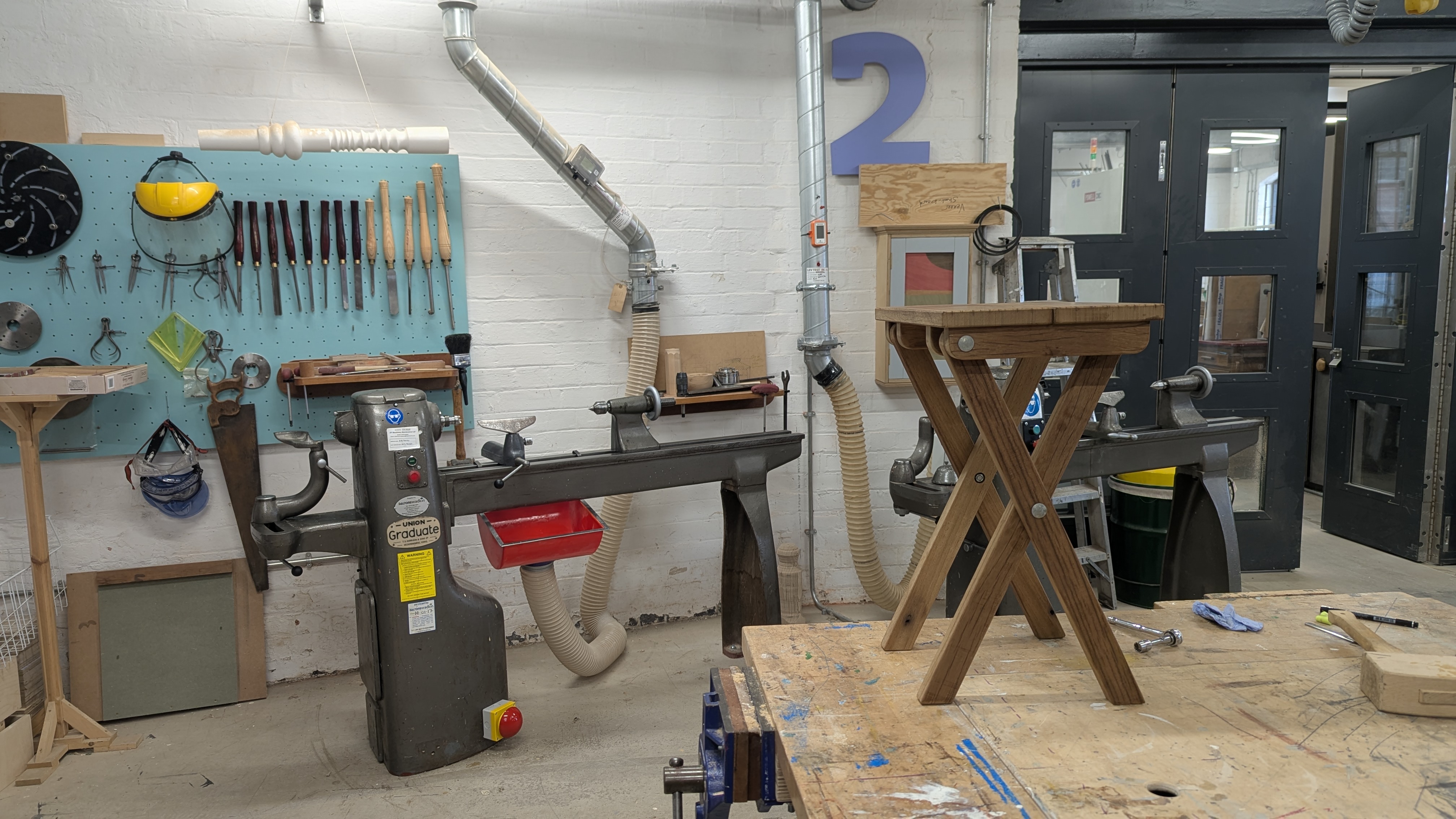
Want to find out more about the Workshop?
Public Workshop at The Museum of Making
Interested in using the Workshop?
Become a Workshop Maker
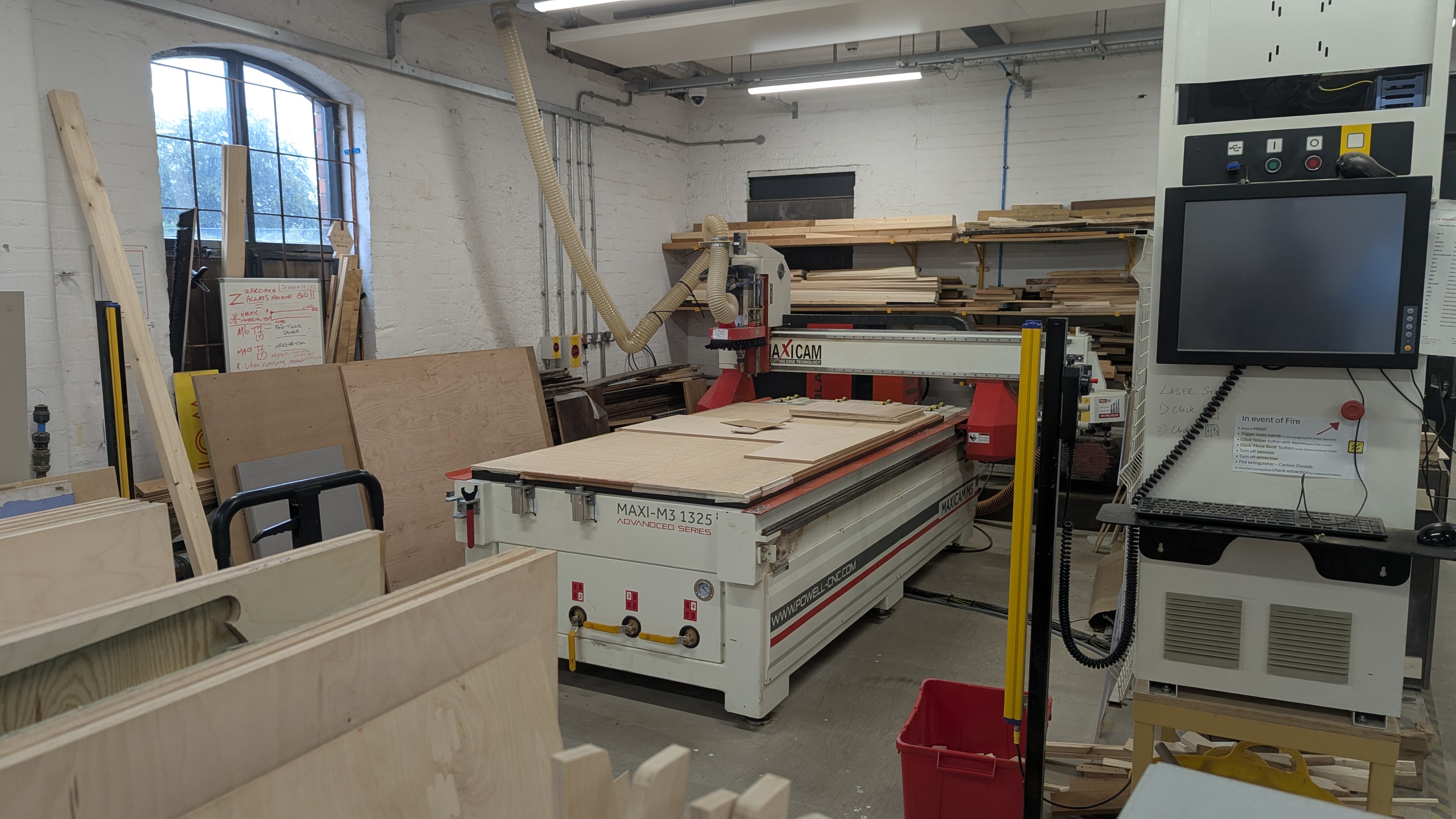
Upcoming Courses:
- Introduction to Tapestry Weaving | 26th September
- Blacksmithing Workshop – Make a Coat Hook | 10th October
- Milk Bottle Mallets | 10th October
- Traditional Upholstery Weekend Workshop | 14th & 15th November
- Lino-Printed Lampshade Workshop | 22nd November
- Canvas Making for Beginners Workshop | 25th November
Dates coming soon:
- Make and use a Drop Spindle
- Basics of CNC Machining and Computer-Aided Programming: Weekend course
Along with the blog, subscribe to our Workshop Newsletter!
The newsletter is a shorter version of our blog in your inbox that will keep you updated.